
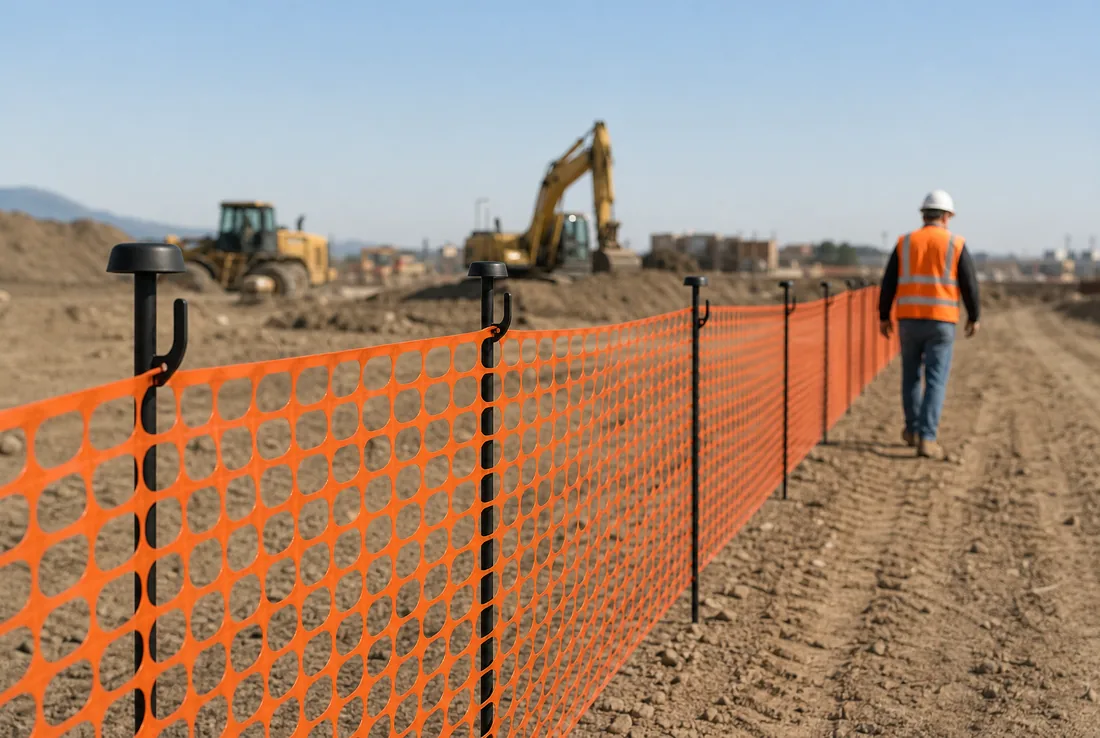
Construction site fencing secures the perimeter for safety, security, and code compliance. The common types are rented chain-link panels, welded-mesh anti-climb panels, driven posts with mesh or barrier fabric, and silt fence for stormwater (SWPPP) control. No single OSHA rule sets a universal fence or height — the requirement comes from the project owner, the site safety plan, and local code. Below: the types, what drives cost, the compliance reality, and how to choose.
What construction site fencing actually does
A construction perimeter is rarely doing one job. On most sites it is doing several at once: keeping the public and trespassers away from active hazards, deterring theft and vandalism of tools and materials, satisfying the owner’s and insurer’s liability expectations, and — where land is being disturbed — holding sediment on site so stormwater leaves clean. The reason there is no single “construction fence” is that these jobs pull in different directions. A high-security panel line and a SWPPP silt run are both “construction site fencing,” but one stops people and the other stops mud.
So the practical question is not “what is the best fence,” it is “which job dominates on this site, and how many times will the fence move before the job is done.” Those two answers point to a format.
The main types, at a glance
| Type | Best for | Trade-off |
|---|---|---|
| Chain-link panels (rented) | The standard security perimeter on most commercial sites | Heavy; needs feet and bracing; rental recurs every month it stands |
| Welded-mesh anti-climb panels | Higher-security or public-facing sites, harder to breach | Higher cost; still a rigid panel system to move and store |
| Posts + mesh or barrier fabric | Fast-moving, phased, SWPPP, or demarcation perimeters | Lighter security than a rigid panel; depends on the post and fabric chosen |
| Silt fence | Stormwater and sediment control (SWPPP) | A sediment barrier, not a people barrier — usually runs alongside the security fence |
The panel-versus-post decision is the one most crews wrestle with, because it is really a question about how often the line moves and who carries the labor. That trade-off is worked through in depth in temporary fence panels vs posts, and the post options themselves — U-posts, T-posts, and reusable barrier posts — are compared in temporary fence posts and U-post vs T-post.
Requirements: what actually binds you
The most common misconception is that OSHA mandates a six-foot fence around every construction site. It does not. OSHA’s construction standards (29 CFR 1926) require that specific hazards be guarded — open excavations, holes, and similar openings — and they set fall-protection and impalement-protection benchmarks, but the perimeter fence and its height are set by the project owner, the site safety plan, and local municipal code, which commonly lands near six feet on commercial sites and higher in some jurisdictions. The honest move is to confirm the binding number with the city or county, not to assume a federal rule. The full breakdown — including the six-foot myth and OSHA’s impalement-protection benchmark — is in T-post safety hazards on construction sites.
There is a second requirement layer that has nothing to do with security. If the site disturbs land above the threshold in its stormwater permit — the EPA NPDES Construction General Permit or an equivalent state permit — then sediment controls such as silt fence are typically required, independent of whatever security fence is in place. What a spec-compliant silt run looks like is covered in silt fence requirements and silt fence installation.
What it costs
Rented chain-link is usually quoted at about $1.50 to $3.00 per linear foot per month, or roughly $20 to $50 per panel per month, plus a delivery fee and any gate, install, or damage-waiver charges. That is an operating cost that recurs every month the fence stands — which is why a perimeter that lives on a site for many months, or redeploys across phases, eventually crosses the line where buying a reusable system is cheaper than renting. The full rental ranges, regional variation, and a buy-versus-rent break-even are in temporary fence rental cost.
How to choose
Match the system to the job, then to how often it moves
Start with the dominant job. Security on a public-facing site points to rigid or anti-climb panels; a fast, phased, or demarcation perimeter points to posts and fabric; a land-disturbing site adds a silt run regardless of the security choice. Then count the moves. A perimeter that stands once and comes down favors the lowest upfront option; a perimeter that redeploys across phases or sites favors a reusable system that spreads its cost across many setups.
| If your priority is... | Lean toward |
|---|---|
| Lowest upfront cost, one short run | Rented panels or driven posts |
| High security on a public-facing site | Welded-mesh anti-climb panels |
| Fast, repeated setup and teardown | A reusable barrier-post system |
| Stormwater / sediment compliance | Silt fence, run alongside the security line |
Where reusable safety-barrier posts fit
Construction site safety is the first application Scepter lists for its flagship product, and the Scepter Post is built for exactly the case above — a construction perimeter that moves. It is a reusable, patented-worldwide barrier post that builds eight safety features into the post, including a built-in safety cap that covers the tube end rather than leaving an exposed top to guard. Scepter states the system installs and dismantles up to 8–10x faster than conventional methods, and its reusable, recyclable materials turn the recurring rental or the repeated driving-and-pulling labor into realized savings per mile across phases.
It is not the answer for every site. For a single short run where the lowest upfront price is the only priority, a rented panel or a driven post still wins. The reusable system pays off when the perimeter redeploys — the more phases or sites you run it across, the better that math gets.
Planning a construction site perimeter?
Send your site type, linear footage, and how often the fence has to move. A Scepter rep can compare rented panels, driven posts, and reusable Scepter Posts for your project.
Frequently asked questions
What is construction site fencing?
Construction site fencing is the temporary perimeter that secures a jobsite for safety, security, and code compliance. The common formats are rented chain-link panels, welded-mesh anti-climb panels, driven posts with mesh or barrier fabric, and silt fence for stormwater control. The right one depends on which job — security, speed, demarcation, or sediment control — matters most on that site.
Does OSHA require fencing around a construction site?
There is no single OSHA rule that mandates a perimeter fence of a set height on every site. OSHA requires that specific hazards be guarded — open excavations, holes, and similar openings under 29 CFR 1926 — and the perimeter fence itself is usually driven by the project owner, the site safety plan, and local municipal code. Confirm the binding height and type with your city or county.
What are the main types of construction site fencing?
Four show up most: chain-link panels (the standard rented perimeter), welded-mesh anti-climb panels (higher security), posts with mesh or barrier fabric (fast, phased, or SWPPP perimeters), and silt fence (a stormwater sediment barrier, not a people barrier). Many sites run more than one at once — for example a security panel line plus silt fence along the drainage edge.
How much does construction site fencing cost?
Rented chain-link commonly runs about $1.50 to $3.00 per linear foot per month, or roughly $20 to $50 per panel per month, plus a delivery fee. Buying a reusable post-and-fabric system is a capital cost that pays off when the perimeter redeploys across phases or sites. Rates vary widely by region and provider, so get multiple quotes.
Do I need silt fence on a construction site?
If the site disturbs land above the threshold in its stormwater permit — the EPA NPDES Construction General Permit or an equivalent state permit — then sediment controls such as silt fence are typically required. That is separate from the security fence: silt fence stops sediment, not people, and the two often run as parallel lines.
What is the most reusable construction site fence?
Reusable barrier-post systems are the most redeployable option, because an intact run lifts out and sets up again instead of being driven and pulled each phase. Rented panels are reusable for the provider but recur as a monthly line item for you, and driven posts are cheap once but labor-heavy to install and remove repeatedly.
Sources & standards
Figures and requirements on this page were checked against primary and industry sources. Always confirm against the governing permit, spec, or a current quote.