
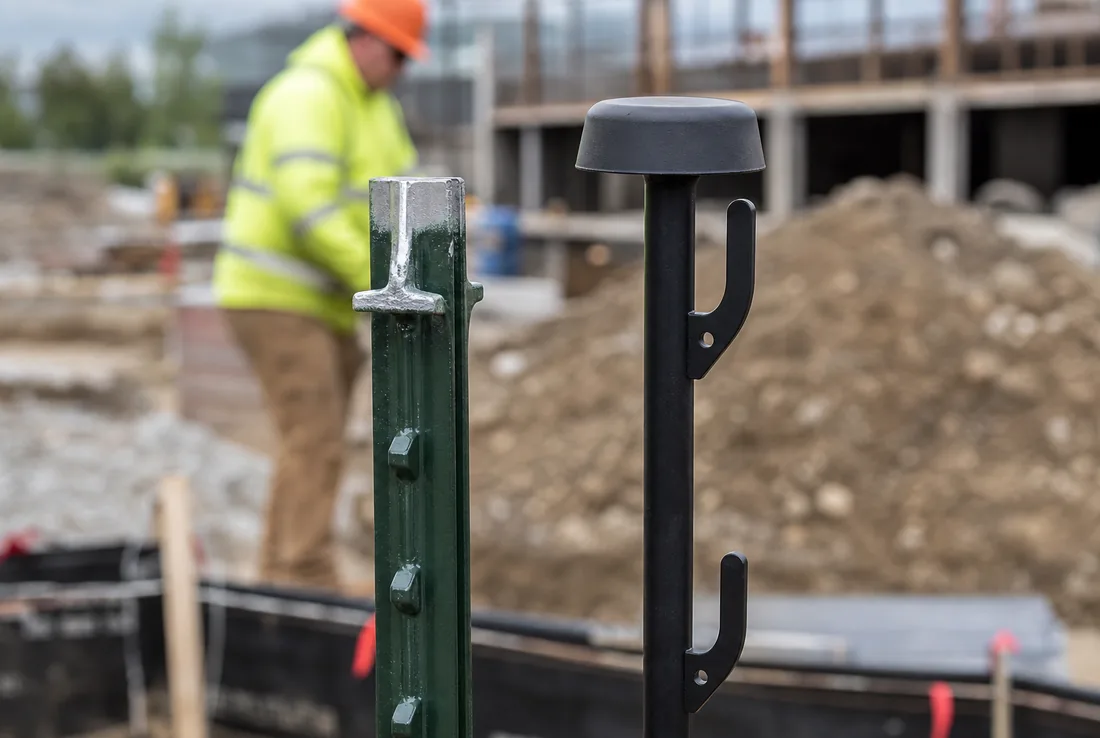
The safety problem with T-posts on a jobsite is usually the workflow, not just the post: exposed metal tops, sledgehammer and post-driver installation, improvised attachment, and removal. The way to evaluate temporary fence posts is to translate those hazards into recordable-incident exposure and downtime, then compare posts on how much manual hazard each workflow creates.
Why T-posts are common on jobsites
T-posts are cheap, strong, and everywhere. They are a sensible default for many fences, which is exactly why their installed workflow rarely gets questioned on temporary jobsite barriers.
Do you need a construction site safety fence?
There is no single OSHA rule that says every site must be wrapped in a perimeter fence. What the standards require is that you control access to hazards: under 29 CFR 1926, excavations and certain openings must be barricaded or guarded, and the public and unauthorized workers must be kept clear of active hazards. Whether a full perimeter fence is mandatory on a given job usually comes from three other places, not OSHA alone:
- The project owner or general contractor, through contract and the site-specific safety plan.
- Local building and zoning codes, which frequently require site fencing during construction.
- The hazard itself — open excavations, fall edges, and public-adjacent work often force a barrier.
On height specifically, a common myth is that OSHA mandates a 6-foot construction fence. It does not. The 6-foot figure that runs through OSHA’s construction rules is the fall-protection trigger in 29 CFR 1926.501 — the edge height at which a worker needs fall protection — not a fence-height rule. The one fence height OSHA does name (an 8-foot equivalent in 1926.403) applies to enclosures around exposed live electrical parts, not site perimeters. The actual minimum height for a perimeter fence comes from local municipal code — commonly 6 feet on commercial sites, more in some jurisdictions — so the binding number is the one your city or county sets, not a federal one.
So the practical question is rarely “does OSHA force a fence here”; it is “what barrier does this spec, code, and hazard set require, and which post makes that barrier safest to install, maintain, and remove.” That is where post choice — and the hazards below — actually matter.
The safety problem is the workflow, not only the post
A post by itself is inert. The exposure comes from how it is installed, attached, and removed, repeatedly, by rotating crews, under schedule pressure. Evaluating only the post misses where the risk actually lives.
Hazard: exposed post tops
A bare steel post top is a contact and impalement hazard — a worker who trips or falls onto an exposed top can be cut or, in the worst case, impaled. Caps reduce the everyday contact risk, but a cap is an extra part that gets skipped, knocked off, or run out of on site.
There is a compliance trap worth knowing here. OSHA’s specific impalement standard, 29 CFR 1926.701(b) (“all protruding reinforcing steel, onto and into which employees could fall, shall be guarded to eliminate the hazard of impalement”), applies to rebar only. A steel fence post is not rebar, so the protruding-post hazard is governed instead by the housekeeping rule §1926.25(a) and OSHA’s General Duty Clause — the obligation to keep the site free of recognized hazards. The duty to control the hazard still applies; it just comes from a different rule.
The second trap is the cap itself. By OSHA’s own interpretations, the common plastic “mushroom” cap is scratch protection, not impalement protection — cap manufacturers say so, and OSHA’s benchmark for true impalement guarding is a cover that can withstand a 250-pound weight dropped from 10 feet. So a cap on a post top makes it safer to brush against, but it does not make a fall onto that post top safe. The reliable controls are eliminating the exposed top, guarding it with a tested cover, or preventing the fall in the first place — not assuming a snap-on cap has solved impalement.
Hazard: impact-tool installation
Driving posts with a sledgehammer or manual post driver concentrates force, repetitive strain, and struck-by exposure. The taller the post and the harder the ground, the worse it gets.
Hazard: inconsistent attachment
Zip ties, wire, and clips applied by whoever is on the crew that day produce inconsistent barriers. Inconsistent attachment is both a quality problem and a snag/laceration exposure.
Hazard: teardown and removal
Pulling driven posts is a second labor event with its own strain and struck-by exposure, often done fast at closeout when attention is lowest.
How safety teams should evaluate temporary fence posts
Translate field pain into risk and downtime
Count the exposures per deployment: posts driven by impact tool, caps required, improvised attachments, and posts pulled at teardown. Multiply by redeployments per year. That is the recordable-incident surface and the nonproductive crew time a safer workflow can reduce.
| Workflow step | Traditional T-post exposure | What a safer system changes |
|---|---|---|
| Top | Exposed steel top unless capped | Built-in safe top, no separate cap to lose |
| Install | Sledgehammer / post-driver impact work | No post-driver-centered workflow |
| Attach | Zip ties, wire, bent clips | Consistent clip-on attachment |
| Teardown | Pull driven posts; strain and struck-by | Pulls cleanly for reuse |
Reusable safety-barrier posts as a risk-reduction option
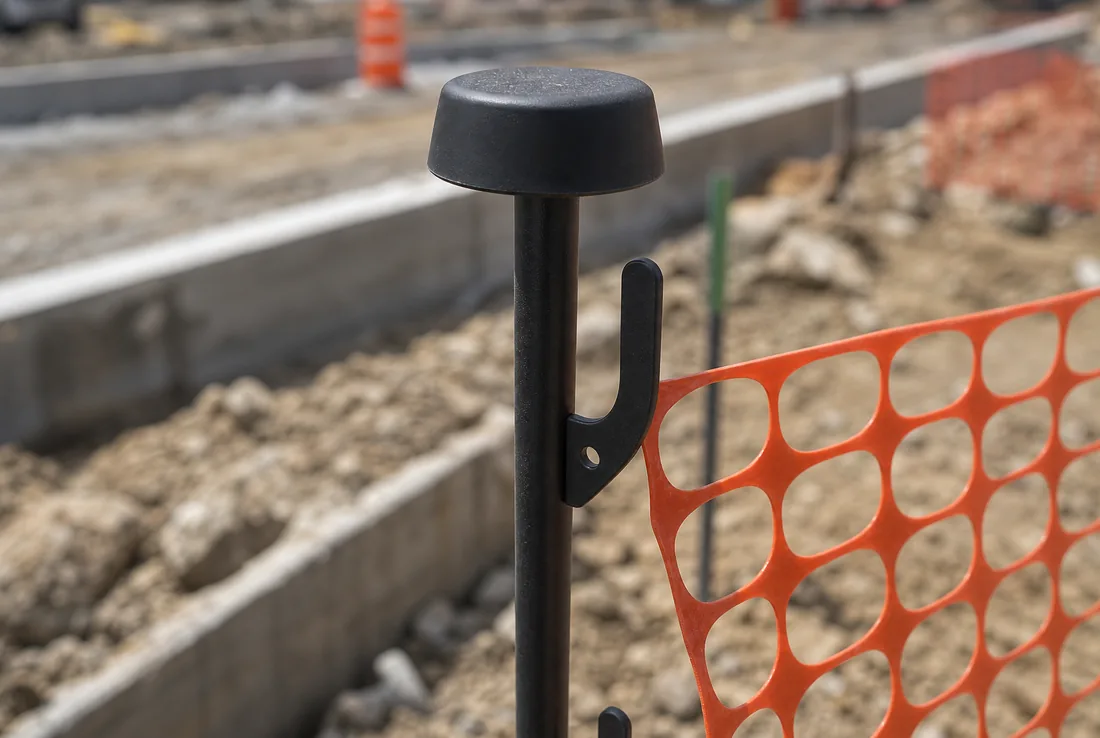
This is the workflow Scepter built its post around. Scepter lists eight built-in safety features aimed at the hazards above — starting with a built-in safety cap that covers the tube end instead of leaving an exposed top to guard or improvise. The cloth clips onto the post’s hooks rather than being driven and wired, so there is no sledgehammer-centered install, and the run lifts out intact for reuse; Scepter states the system installs and dismantles up to 8–10x faster than conventional methods — exactly the repetitive install-and-teardown exposure where these injuries happen. The honest framing is risk reduction in that workflow, not a promise about insurance rates. For how the post types compare on the bench, see U-post vs T-post and temporary fence posts; to weigh the install-and-teardown labor a safer workflow removes, use the temporary fence cost calculator.
What this does not claim
A safer post does not replace a site safety program, and it is not a claim of lower EMR or guaranteed incident reduction. It reduces specific manual hazards — exposed tops, impact-tool work, improvised attachment — in temporary-barrier install and teardown.
Evaluating safer temporary barriers?
Get the Scepter safer-barrier resources, or send your project so a rep can walk a safety team through the install and teardown workflow.
Frequently asked questions
Are exposed T-post tops a safety hazard?
Yes. An uncapped steel post top is a contact and impalement hazard on a jobsite where people move, carry materials, and work nearby. Many crews add caps, but caps are an extra step and an extra part that can fall off or be skipped. Follow your safety program and applicable standards.
Do T-post safety caps meet OSHA impalement requirements?
Not necessarily. OSHA's specific impalement standard, 29 CFR 1926.701(b), applies to rebar, not fence posts — the protruding-post hazard is covered by the housekeeping rule 1926.25(a) and the General Duty Clause. And by OSHA's own interpretations, the common plastic mushroom cap is scratch protection, not impalement protection; OSHA's benchmark for true impalement guarding is a cover that withstands a 250-pound weight dropped from 10 feet. A cap makes a post top safer to brush against but does not make a fall onto it safe. The reliable fix is eliminating or properly guarding the exposed top, or preventing the fall.
Does Scepter lower my EMR?
We do not claim a premium post lowers your experience modification rate. A single product is too small a lever to promise that. The honest case is that reducing exposed-post and impact-tool exposure can support a safer temporary-barrier workflow, which is one input safety teams and PMs care about.
What is a safer alternative to driving T-posts?
A reusable safety-barrier post with a built-in safe top and clip-on attachment reduces sledgehammer and post-driver work and improvised attachment. It is not a substitute for a complete site safety program, but it removes several of the manual hazards in temporary-barrier install and teardown.
Does OSHA require fencing around a construction site?
OSHA does not impose a single, universal rule that every construction site be enclosed by a perimeter fence. It does require employers to control access to hazards — for example, excavations and certain openings must be barricaded or guarded under 29 CFR 1926. Perimeter fencing itself is usually required by the project owner or general contractor, the site-specific safety plan, and local building codes, so check those alongside the OSHA standards.
How tall does a construction site fence have to be? Does OSHA require 6 feet?
OSHA does not set a 6-foot construction perimeter-fence height — that is a common myth. The 6-foot figure in OSHA's construction rules is the fall-protection trigger in 29 CFR 1926.501, the edge height at which fall protection is required, not a fence-height rule. The only fence height OSHA names is an 8-foot equivalent for enclosures around exposed live electrical parts (1926.403), which is unrelated to site perimeters. Actual perimeter-fence height comes from local municipal code, commonly 6 feet on commercial sites and more in some jurisdictions, so confirm the binding number with your city or county.
Sources & standards
Figures and requirements on this page were checked against primary and industry sources. Always confirm against the governing permit, spec, or a current quote.