
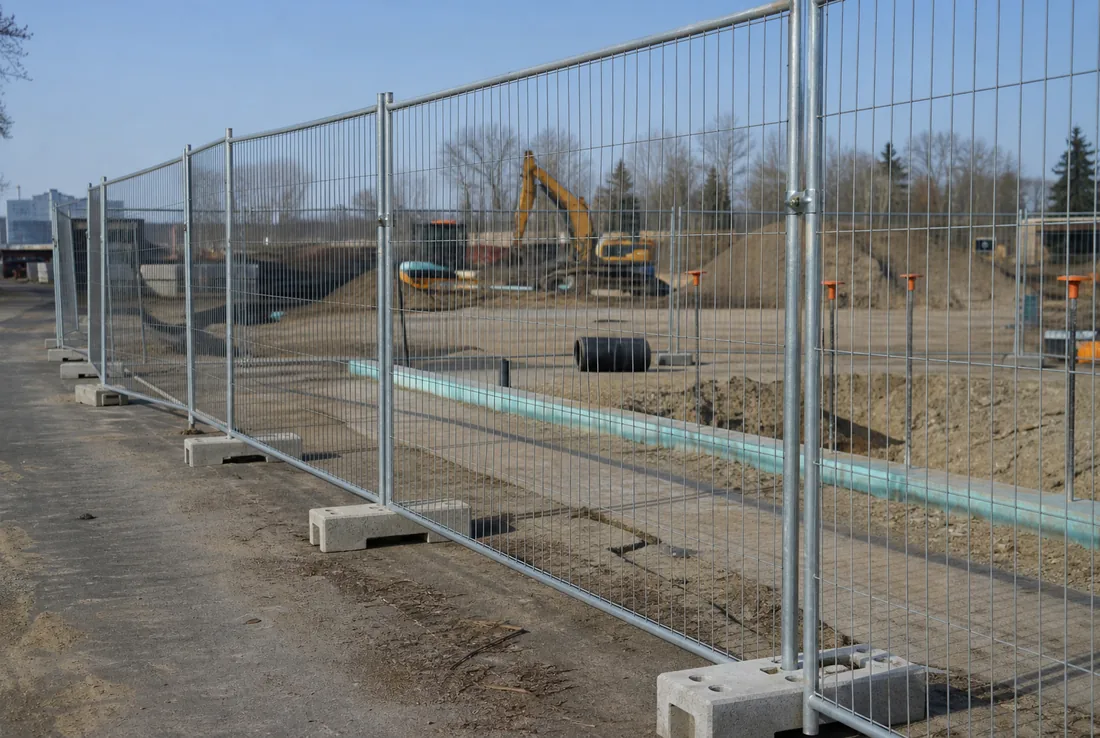
The choice is about the barrier format, not just the post. Panels are free-standing fence sections on feet or blocks — fast, full-coverage, usually rented, with no ground penetration. Posts carry mesh or fabric on driven or base-plated supports — better for long or contoured perimeters, SWPPP and erosion control, and barriers you reuse. Panels win for instant security on short urban jobs; posts win for SWPPP, contoured runs, and lifecycle reuse. Below is the honest breakdown by job type.
What temporary fence panels are
Temporary fence panels are pre-made fence sections — usually chain-link in a frame — that stand in plastic or concrete feet and clamp together. They are typically rented, install fast, leave no holes in the ground, and give an immediate full-coverage perimeter. That makes them the default for urban construction sites, events, and short-duration security.
The construction standard is a 6 ft high panel, commonly 10 to 12 ft wide (12 ft is the most common), around 28–51 lbs depending on gauge, in either standard mesh or tighter anti-climb mesh (about 2 in openings) for security work. Each panel typically needs one base stand and two couplers to lock to its neighbors, so a job’s hardware count is roughly one stand and two clamps per panel plus the panels themselves — useful when you price a rental by the linear foot.
What post-based temporary fences are
Post-based fences carry mesh, fabric, or wire on supports driven or base-plated into the ground. This is the format behind silt fence, work-zone barriers, and most contoured or long perimeters. The post can be a commodity T-post, a U-post, or a reusable safety-barrier post; see U-post vs T-post and temporary fence posts for the post-level comparison.
Panels vs posts: side by side
| Factor | Panels | Posts (incl. reusable) |
|---|---|---|
| Setup speed | Very fast, no driving | Driving adds labor; reusable posts cut it |
| Ground disturbance | None (free-standing) | Driven posts penetrate; base-plated do not |
| Full-coverage security | Strong — solid panel line | Depends on mesh; less of a security wall |
| Long / contoured runs | Bulky, awkward on slopes | Follows terrain and length well |
| Wind stability | Free-standing — needs ballast, worse with screens | Driven posts resist wind; base-plated need weight too |
| SWPPP / silt fence | Not suitable | Required format (trenched fabric on posts) |
| Cost model | Recurring rental | Upfront buy or reuse + install/teardown labor |
| Reuse / redeploy | Return at end of rental | Owned or reusable; redeploys across jobs |
| Storage / transport | Rental company handles it | You store and haul owned inventory |
When panels win
Choose panels when...
The job is a short-duration, full-coverage security perimeter — an urban site, an event, a secure-the-lot rental — where instant coverage and no ground penetration matter more than terrain fit or reuse, and a recurring rental cost is acceptable. For that job, panels are usually the right call and we will say so.
When posts win
Choose posts when...
The barrier follows a long or contoured perimeter, the job is SWPPP or erosion control (which requires trenched fabric on posts), the work is phased, or you want a barrier you own and redeploy across projects. Here a post-based system — including a reusable safety-barrier post that installs and tears down without a driver — usually fits better and costs less over the life of the work.
The wind problem with panels
The most common way a panel fence fails is not getting cut — it is blowing over. Free-standing panels sit in feet, not in the ground, so wind load is resisted only by ballast. Add a privacy screen or debris netting and you turn the fence into a sail: the same wind now pushes on a solid surface instead of through open mesh. The fix is engineered weight — heavier concrete feet, sandbags or water ballast, panel-to-panel bracing, and extra weight at the corners, ends, and gates where leverage is highest.
This is the quiet edge of a post-based system on an exposed or long-duration site. A post driven into the ground carries wind without ballast, and a base-plated reusable post can be weighted or anchored at the points that matter. If your site is open, windy, or screened for dust control, account for the ballast a panel line actually needs before you assume panels are the cheaper, simpler call.
The cost models are different
Panels and posts are not just different hardware; they are different ways to pay. Panels are usually a recurring rental, simple to budget for a fixed short term. Posts are usually an upfront purchase or reusable inventory, where install and teardown labor — repeated each phase — drives the real cost. To compare rent-vs-own-vs-reusable for your duration and redeployment count, use the temporary fence cost calculator and the temporary fence rental cost guide.
For a construction site specifically
A jobsite perimeter is rarely one decision. Many sites use panels for the secure street frontage and post-based fencing or silt fence for the back-of-site erosion control and longer runs. The honest question is not “panels or posts” globally — it is “which barrier does each part of this site need, for how long, and will I redeploy it.” Where the answer is long-duration, contoured, erosion-related, or redeployed, a reusable post system is worth pricing against rented panels.
Deciding panels vs posts for a real site?
Send your perimeter, duration, security needs, and whether erosion control is in scope. A Scepter rep can compare rented panels, T-posts, and reusable Scepter Posts for each part of your site.
Frequently asked questions
Are temporary fence panels or posts cheaper?
It depends on duration and how often the barrier moves. Panels are usually rented, so cost is recurring monthly and predictable for a short job. Post-based fencing is usually bought or reused, so the cost is upfront plus install and teardown labor. For a short, full-coverage perimeter panels can be cheaper; for long or phased work, owned or reusable posts often win over time.
Can you use temporary fence panels for silt fence?
No. Silt fence is a sediment-control BMP that requires geotextile fabric keyed into a trench on driven posts. Free-standing panels do not provide the trenched fabric a SWPPP spec requires. Silt fence and erosion control are post-and-fabric jobs, not panel jobs.
Which is better for a construction site, panels or posts?
For an instant, full-coverage security perimeter on an urban or short-duration site, rented panels are hard to beat. For long or contoured perimeters, phased work, SWPPP and erosion control, or a barrier you will redeploy across projects, post-based fencing — including reusable post systems — usually fits better and costs less over time.
Do temporary fence panels need posts?
Free-standing panel systems use their own feet or blocks instead of driven posts, which is why they install fast and leave no ground penetration. Post-based fencing uses driven or base-plated posts that carry mesh or fabric. They are two different barrier formats, which is the core of the panels-vs-posts decision.
What size are temporary construction fence panels?
The construction standard is a 6 ft high welded-mesh panel, commonly 10 to 12 ft wide (12 ft is the most common), usually 28 to 51 lbs depending on gauge, in standard or tighter anti-climb mesh. Each panel typically needs one base stand and two couplers to lock to its neighbors, so you can estimate hardware as roughly one stand and two clamps per panel.
Do temporary fence panels blow over?
They can. Free-standing panels resist wind only through their ballast, and adding a privacy screen or debris netting turns the line into a sail that catches far more wind. On exposed sites they need heavier feet, sandbag or water ballast, panel-to-panel bracing, and extra weight at corners, ends, and gates. A driven post-based fence carries wind without ballast, which is one reason posts can win on open or long-duration sites.