
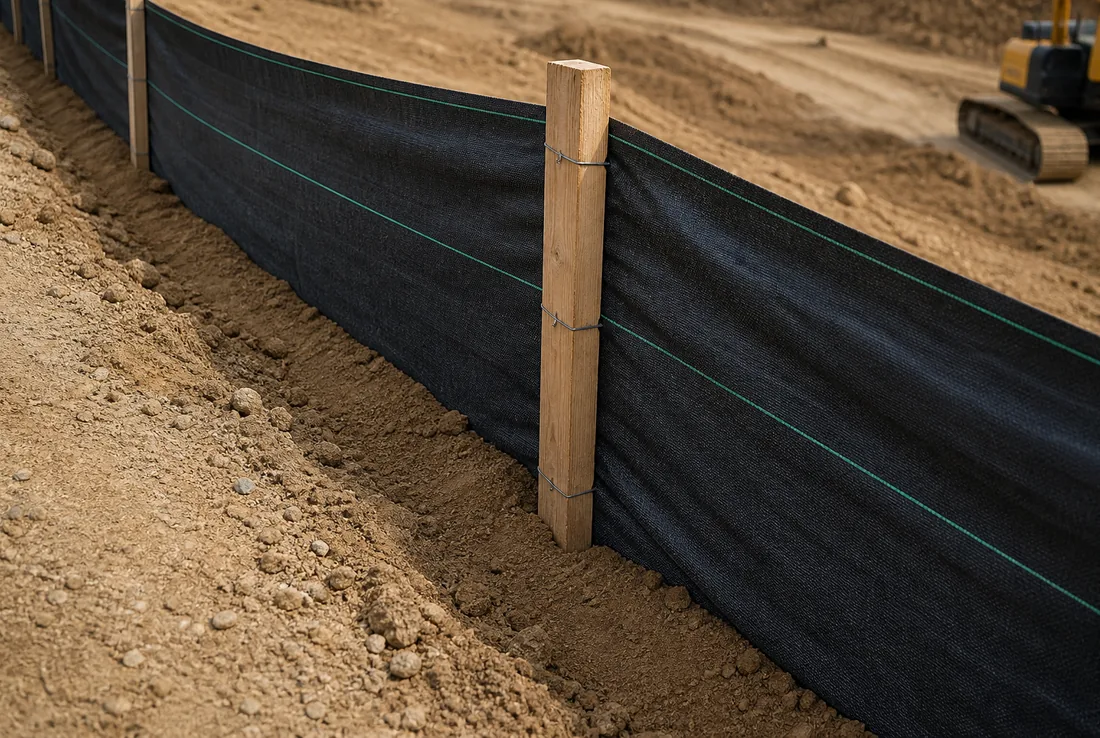
Silt fence requirements come from a stack: a stormwater permit (the EPA NPDES Construction General Permit or a state equivalent), the governing DOT or erosion-control standard, and the site-specific SWPPP. Typical baseline requirements are posts 6 to 10 feet apart, 12 to 18 inches of embedment, fabric keyed into a trench, and routine plus post-storm inspections. The spec that governs your site always overrides any rule of thumb. This page covers what the requirements usually are, where they come from, and how inspection works.
Where silt fence requirements come from
Silt fence is a sediment-control best management practice (BMP), and the rules for it are regulatory, not just good practice. They come from three layers:
- The stormwater permit. Construction that disturbs land above a threshold is usually covered by the EPA NPDES Construction General Permit or an authorized state permit. The permit requires sediment controls.
- The DOT or state erosion-control standard. State transportation and environmental agencies publish standard specs that prescribe post type, spacing, embedment, fabric, and trenching.
- The site-specific SWPPP. The Stormwater Pollution Prevention Plan translates the permit and standards into the controls that must be installed and maintained on your site.
When these conflict, the more stringent requirement usually governs — and the SWPPP and permit are the documents an inspector will hold you to.
When do silt fence requirements apply?
Stormwater permit coverage is usually triggered by the area of land disturbed. Under the federal NPDES Construction General Permit, a site that disturbs one acre or more — or less than an acre but part of a larger common plan of development that totals an acre or more — generally needs permit coverage and a SWPPP, which is what brings in sediment controls like silt fence. Smaller sites can still be pulled in by a local ordinance. Two more rules an inspector applies on day one:
- Silt fence is a sediment control, not an erosion control. It captures soil that has already moved; it does not stop soil from eroding. It is one BMP in a plan, not the whole plan.
- Perimeter controls go in first. Sediment controls must be installed before the ground disturbance they protect against — not after grading starts.
The material and installation themselves are commonly specified against the ASTM standards for silt fence — ASTM D6461 (geotextile material) and ASTM D6462 (installation practice) — which many state specs reference directly.
Common silt fence spec requirements
These are typical values. Read them as a starting point and confirm against the governing spec, which controls.
| Requirement | Typical spec | Why it matters |
|---|---|---|
| Post spacing | 6 – 10 ft baseline; many specs require tighter for standard fence | Span controls sag and blowout; tighten on slopes and tension points |
| Post embedment | 12 – 18 in driven depth | Shallow posts lean or pull under load |
| Fabric trench / keying | Keyed into a trench below grade | Stops runoff from undercutting the fence |
| Fabric type | Spec-listed woven fabric; wire-backed where required | Flow rate and strength must meet the spec |
| Post type | Wood or steel, per spec; reusable where allowed | Substitutions must be spec-approved |
For driving depth, post options, and field install notes, see temporary fence posts and the silt fence installation guide.
Silt fence inspection requirements
Installation is only half of compliance. The permit also sets how often the control is inspected and what gets documented.
| Inspection element | Common requirement |
|---|---|
| Routine cadence | Every 7 days — or every 14 days plus within 24 hrs of a qualifying storm |
| Storm trigger | 0.25 in under the federal CGP; some state permits use 0.5 in |
| What is checked | Undermining, sagging, tears, sediment depth, end-runs, anchoring |
| Maintenance trigger | Sediment reaching about one-third to one-half fence height |
| Records | Dated inspection reports; typically retained 3 years after coverage ends (longer where the permit requires) |
Intervals and triggers vary by permit and state — the federal Construction General Permit values above are a common baseline, not a universal rule. Your SWPPP states the cadence you are held to.
Common violations and how they happen
- No trench. Fabric laid on the surface lets runoff flow underneath — a frequent finding.
- End-runs. Water goes around an unturned end; ends should be turned upslope.
- Overloaded fence. Sediment not removed at the trigger depth overtops or collapses the fence.
- Skipped inspections. Missing or undated reports are a compliance problem even if the fence is fine.
A non-compliant control can mean a corrective-action notice, re-installation, or stormwater-violation exposure — costs that dwarf the install price. See silt fence cost for how pricing the install-and-maintain scope, not just materials, protects the bid, and the temporary fence cost calculator to size the install-and-teardown labor.
Choosing spec-compliant posts
Scepter’s silt range is built to drop into these requirements rather than around them: the Engineered Silt Cloth is a woven-polypropylene geotextile — the material most fabric specs call for — and posts set 11.75 inches deep with the skirt keyed at least 12 inches into a backfilled trench, the standard embedment and trenching most jurisdictions require. Where a spec calls for reinforced or wire-backed silt fence, the wire-backed Silt 4X4HD and 2X4HD meet that without a separate system; where it requires extra freeboard (solar fields, sensitive zones), the Engineered Extended Silt Cloth adds an 18-inch skirt. Confirm the approved post type first, then match the product to the requirement.
Substituting posts within the spec
Allowed and worthwhile: where the spec permits a post type rather than naming one product, a reusable post can cut install and teardown labor across phased erosion-control work. Not allowed: substituting a post the spec does not approve, or changing spacing or embedment to save labor. The spec governs; the labor savings only count when the substitution is spec-compliant.
Confirming a spec-compliant silt fence setup?
Get Scepter SWPPP and spec resources, or send your spec and linear footage so a rep can confirm a compliant, lower-labor post setup for your erosion-control scope.
Frequently asked questions
What are the spacing requirements for silt fence?
Silt fence posts are commonly required to be spaced 6 to 10 feet apart and embedded 12 to 18 inches deep, per U.S. EPA stormwater guidance and many state erosion-control standards. Slopes, tension points, and heavy fabric often call for tighter spacing. The governing SWPPP or DOT spec is the authority and overrides any general rule of thumb.
How often does silt fence need to be inspected?
Under the federal NPDES Construction General Permit, sites are commonly inspected either every 7 days, or every 14 days plus within 24 hours of a qualifying storm — 0.25 inch under the federal permit, though some state permits use 0.5 inch. State permits and the site SWPPP can set different intervals, so follow the permit that governs your site. Inspection reports should be dated and kept, typically for three years after coverage ends.
Do I need a SWPPP and silt fence for a site under one acre?
Usually you need permit coverage and a SWPPP when a construction site disturbs one acre or more, or less than an acre but part of a larger common plan of development that totals an acre or more. Below that, a local ordinance can still require sediment controls. When a SWPPP applies, it typically requires perimeter sediment controls like silt fence, installed before ground disturbance begins.
What ASTM standard covers silt fence?
Silt fence is commonly specified against ASTM D6461, the standard specification for the geotextile material, and ASTM D6462, the standard practice for silt fence installation. Many state DOT and erosion-control specifications reference these directly, so a spec-compliant fence usually means meeting the ASTM material and installation requirements the project calls out.
Does silt fence have to be trenched in?
Most specs require the fabric to be keyed into a trench below grade so runoff cannot flow underneath. A silt fence laid on the surface without trenching is a common cause of failure and inspection findings. Confirm the trench depth and method in your spec.
Who is responsible for silt fence maintenance?
On a permitted construction site, the operator named on the permit is responsible for installing, inspecting, and maintaining sediment controls, including silt fence. Responsibility is usually flowed down by contract to the contractor doing the erosion-control work, but the permit holder remains accountable.
What permit requires silt fence?
Sediment controls like silt fence are typically required by a stormwater permit — the EPA NPDES Construction General Permit or an equivalent state permit — for construction that disturbs land above a threshold area. The site-specific SWPPP translates the permit into the controls, including silt fence, that must be installed and maintained.
What are the penalties for not installing required silt fence?
Because silt fence sits under a site's NPDES stormwater permit, failing to install or maintain a required control is a Clean Water Act violation, not just a paperwork miss. Federal civil penalties are assessed per day, per violation and reach into the tens of thousands of dollars a day at the top of the range, with the exact figure adjusted for inflation each year. In practice, though, most enforcement starts as a state-issued notice of violation or an administrative order to fix the problem — often with a stop-work order until it is corrected — and state programs set their own amounts, which vary widely. The stop-work delay and re-mobilization usually cost more than the fine itself, which is why a correctly installed, inspected fence is cheap insurance. Confirm specifics against your permit and state stormwater agency.
Sources & standards
Figures and requirements on this page were checked against primary and industry sources. Always confirm against the governing permit, spec, or a current quote.
- EPA 2022 NPDES Construction General Permit (CGP)
- EPA — Stormwater discharges from construction activities
- EPA — Clean Water Act Section 309 (federal enforcement authority)
- ASTM D6461 — Standard specification for silt fence materials
- ASTM D6462 — Standard practice for silt fence installation
- USDA NRCS Conservation Practice Standard 382 (Fence)