
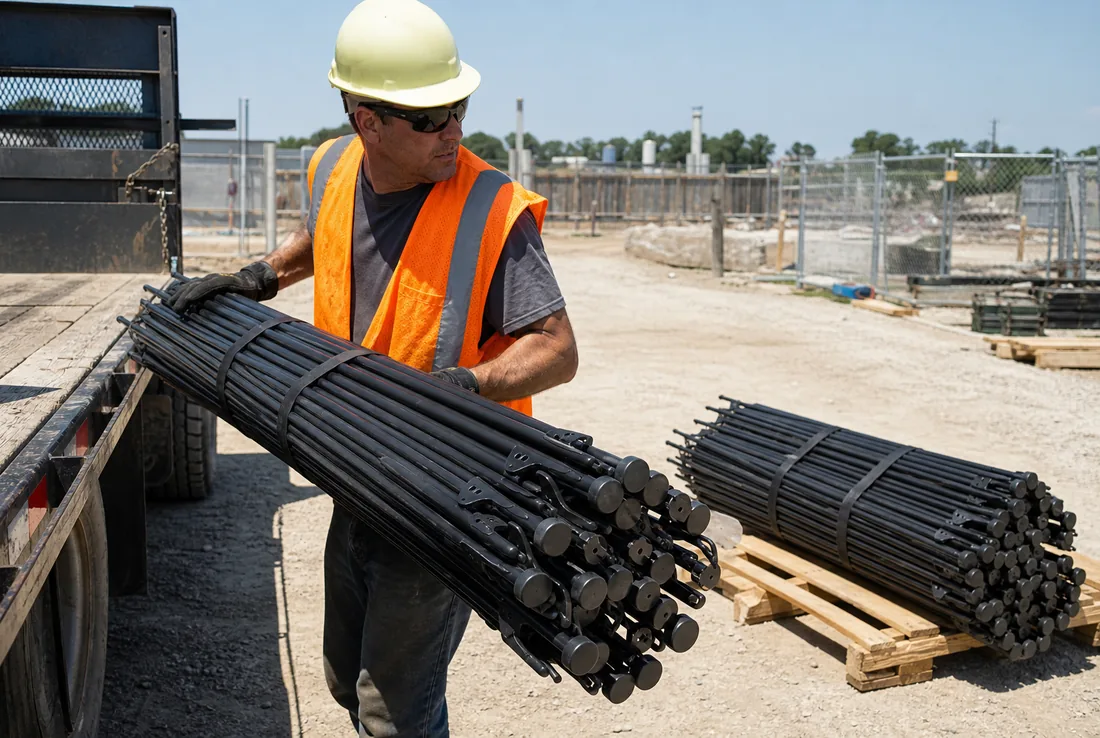
Temporary fence rental typically runs about $1.50 to $3.00 per linear foot per month for standard chain-link — roughly $750 to $1,250 per month for a 500-foot perimeter before a $200 to $600 delivery fee and any install or add-on charges. Total cost depends on perimeter length, project duration, delivery and setup, panels or post-and-mesh, gates, stabilizers, and labor. For repeat projects, reusable fence posts can beat rental or commodity posts once install, teardown, storage, and redeployment are included. This page is not a claim that Scepter is the cheapest post. It shows that post price is not the full project cost.
Cost drivers: what actually moves the number
| Cost driver | Why it matters | What to capture for a quote |
|---|---|---|
| Install labor | Crew size and hours usually outweigh post unit price. | Linear feet, crew size, hourly rate |
| Teardown | Pulling and sorting posts is a second labor event. | Project duration, remobilizations |
| Rental duration | Rental is convenient but adds up over long or repeat projects. | Rental quote, months, panels/gates |
| Reuse | Only compounds when the buyer has repeat deployment. | Projects per year, storage plan |
| Loss / damage | Lost or bent inventory becomes replacement cost. | Loss rate, storage and handling |
What temporary fence rental actually costs
Rental is usually quoted per linear foot per month, or per panel per month, plus delivery and add-ons. Use these as planning ranges — providers vary 30 to 50% for the same scope, so get multiple quotes.
| Item | Typical rate | Note |
|---|---|---|
| Standard chain link | $1.50 – $3.00 / ft / month | Or about $20 – $50 per 6x12 ft panel / month |
| Welded wire mesh | $1.75 – $2.75 / ft / month | Cleaner look; mid-range |
| High-security panels | $2.50 – $4.00 / ft / month | Anti-climb / solid; top of range |
| Plastic / mesh safety fence | $0.50 – $1.00 / ft / month | Visual barrier only, not security |
| Delivery + pickup | $200 – $600 / project | Distance-based; small jobs can be $50 – $200 |
| Install / removal | +$1 – $2 / ft (or $100 – $500) | Labor often $30 – $50 / hr |
| Gates | $150 – $400 each | Per opening |
| Damage waiver | 8 – 12% of rental total | Common add-on |
So a 500-foot standard chain-link perimeter runs roughly $750 to $1,250 per month to rent, before add-ons — versus about $4,000 to $6,000 to buy the same fence outright. That ratio is the whole point of the rent-vs-own decision: rental is cheap to start and never stops; ownership is paid once. Long-term (6+ month) rentals often earn 10 to 20% discounts, and peak spring/summer season can add 10 to 20% — both of which push long or repeat projects toward owning or reusing.
Break-even: when reusable posts win
The break-even point is the number of deployments at which a reusable system’s higher upfront cost is offset by lower install, teardown, and rental cost. As a rule of thumb, the more times the same posts are installed and pulled, the sooner reuse pays back. Use the estimator below to size it for your project, then confirm the result with a Scepter rep against a real quote.
Estimate how many deployments it takes for a reusable post system to pay back its upfront cost. This is a planning estimate, not a quote. Confirm with a Scepter rep.
Want to bookmark or share just the tool? It lives on its own page: Temporary Fence Cost Calculator.
Rental vs buy vs reusable
| Option | Best when | Watch-outs |
|---|---|---|
| Rent panels | Short, single project; no storage; fast mobilization | Cost per month compounds; long or repeat jobs get expensive |
| Buy commodity posts (T/U) | Low-spec perimeter; willing to drive and pull each time | Install/teardown labor; caps and clips; bent inventory |
| Reusable barrier posts | Repeat deployment across projects or a fleet | Higher upfront cost; needs a storage and inventory plan |
How to read the break-even
The break-even is not a guaranteed ROI. It is the point where labor saved plus rental avoided across your redeployments outweighs the higher upfront cost of a reusable system. The more often you install, remove, and redeploy the same perimeter, the sooner that point arrives.
When renting or commodity posts win
For a single short project with no storage and no repeat use, renting panels or buying commodity posts is often the right, lower-cost call. A reusable system earns its place on repeat deployment, fleets, and standardized multi-project work.
Send us your numbers
Share your perimeter length, project count, and expected redeployments. A Scepter rep will return a reusable-post break-even quote — not a generic price list.
Frequently asked questions
How much does temporary fencing cost?
Temporary fencing cost depends on perimeter length, project duration, delivery and setup, whether you rent panels or buy post-and-mesh, gates, stabilizers, and labor. Rental is often quoted per panel per month; buying posts shifts cost toward install labor, teardown, storage, and reuse. The break-even between renting and buying depends on how many projects reuse the same inventory.
How much does it cost to rent temporary fence per month?
Standard chain-link construction fence typically rents for about $1.50 to $3.00 per linear foot per month, or roughly $20 to $50 per 6-by-12-foot panel per month, plus a $200 to $600 delivery fee and any install, gate, or damage-waiver charges. A 500-foot perimeter runs about $750 to $1,250 per month before add-ons. Rates vary 30 to 50% by region and provider, so get multiple quotes.
Is it cheaper to rent or buy temporary fence?
For a single short project, renting is often cheaper and simpler. For repeated deployments across many projects or a fleet, buying a reusable post system can cost less once install labor, teardown, rental months, storage, and redeployment are included. Use the calculator to estimate your break-even, then confirm with a quote.
How long can you rent temporary fencing, and is there a minimum period?
Most providers set a minimum rental period — commonly a 28-day cycle, though some use a one-week or one-month minimum — and then bill month-to-month after that. Short jobs still pay the minimum, while longer jobs (roughly 3 months and up) usually move to long-term billing with discounts of about 10 to 20 percent. Billing is often a 28-day cycle charged in advance, so confirm the cycle and minimum on the quote.
Does temporary fence rental include delivery and installation?
Sometimes, but do not assume it. Some quotes bundle delivery, setup, and pickup into the rate; others itemize them, with delivery, installation, and removal each commonly running a few hundred dollars. Damage waivers and replacement charges for lost or bent panels are also separate. Ask for an itemized quote so the monthly rate, transport, setup, teardown, and any waiver are all spelled out.
Does Scepter Post sell the cheapest fence post?
No. Scepter is not positioned as the cheapest post. The value case is installed-and-reused cost over repeat projects, not the lowest unit price. For a one-time low-spec fence, a commodity post is usually cheaper.