
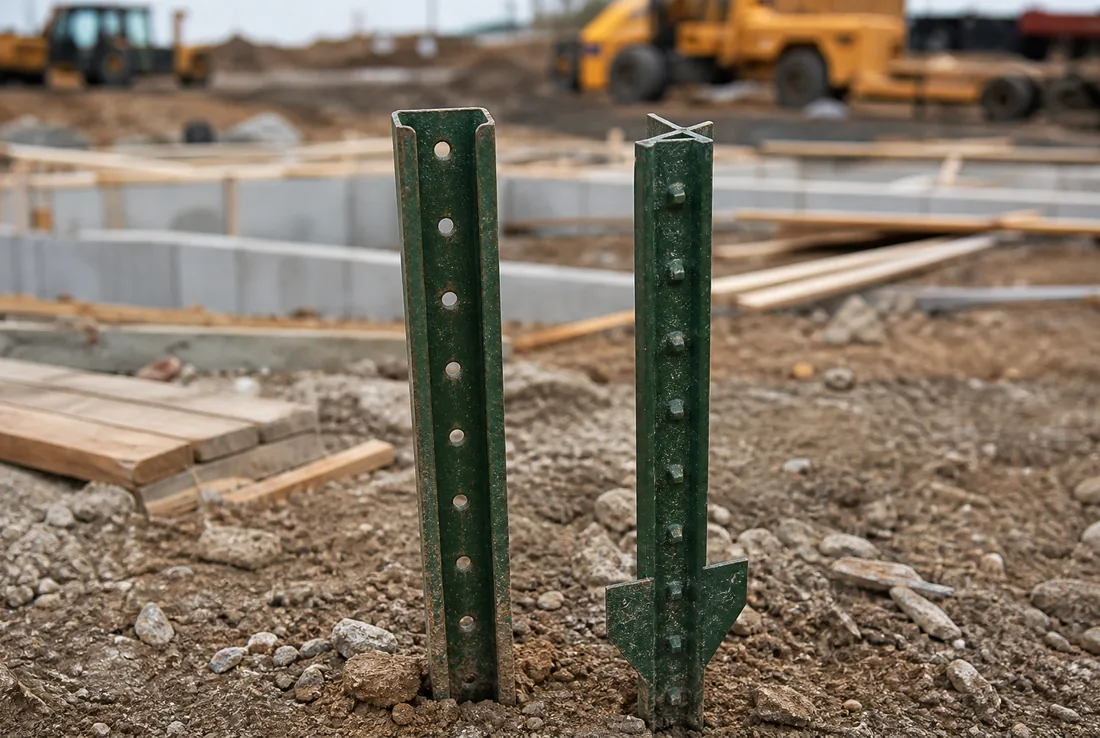
Use U-posts for light garden fencing and small temporary wire runs. Use T-posts for heavier wire fencing, livestock, and longer farm runs. For temporary construction barriers, SWPPP perimeters, and repeated jobsite deployment, compare both against a reusable safety-barrier post system.
Most U-post vs T-post guides stop at shape, strength, and wire attachment. That is useful for a garden fence or a pasture line. It is incomplete when the fence is a construction perimeter that will be installed, moved, removed, stored, and redeployed.
U-post vs T-post comparison
| Category | U-post | T-post | Reusable safety-barrier post |
|---|---|---|---|
| Best fit | Light garden and small temporary fencing | Farm wire, livestock, longer runs | Construction safety, SWPPP, events, fleets, repeat deployment |
| Primary advantage | Simple, low upfront cost | Stronger commodity standard | Faster setup, safer top, clip-on attachment, clean teardown |
| Weakness | Limited strength and jobsite durability | Driving, caps, clips, removal, storage friction | Premium upfront cost; pays off when reused |
| Economic buyer | Homeowner / small farm | Farm, utility, contractor | GC, SWPPP crew, rental fleet, DOT / public works |
What is a U-post?
A U-post is a lighter-duty steel post with a U-shaped cross-section and punched tabs that let wire or mesh attach directly. It is popular for garden fencing, small-animal enclosures, light wire, and short temporary runs, where the priority is low upfront material cost. Its limit is strength and anchoring: U-posts flex under load and struggle across long, high-tension runs.
What is a T-post?
A T-post is a heavier steel post with a studded T-profile and an anchor plate that grips the soil. It is the strong, inexpensive standard for farm, livestock, utility, and wire fencing. The trade-off is the installed workflow: T-posts usually need a post driver to set, wire clips to attach fencing, and removal labor to pull.
Fact: A standard steel T-post weighs about 1.25 to 1.33 lb per foot, and state USDA NRCS Conservation Practice Standard 382 (Fence) specifications commonly require a 1.25 to 1.33 lb/ft minimum (excluding the anchor plate), with the exact figure set by each state’s standard.
Best uses for U-posts
Choose a U-post for light garden and yard fencing, small-animal enclosures, and short temporary wire where lowest upfront cost matters most and loads are light.
Best uses for T-posts
Choose a T-post for farm wire, livestock containment, longer property lines, and barbed-wire runs. They are excellent permanent and semi-permanent farm posts.
Where both fall short on construction sites
On a farm or garden, a post goes in once and stays. On a construction site, the perimeter is installed, moved, reconfigured, removed, and often redeployed several times on one project. That changes which costs matter:
- Install labor. Driving posts and attaching mesh consumes crew-hours, the most expensive input on most sites.
- Attachment inconsistency. Zip ties, wire, and improvised clips vary by crew, so barrier quality varies.
- Removal and teardown. Pulling driven posts is a second labor event, repeated at every closeout.
- Exposed tops. A bare steel post top is a contact and impalement hazard unless capped separately.
- Messy reuse. Bent posts, missing clips, and mixed inventory turn “reusable” into a sorting and replacement cost.
When a U-post or T-post is the right answer
If the job is a one-time backyard garden fence where the lowest upfront post price is the only priority, a U-post or T-post probably wins. A reusable system only earns its place when the buyer installs, removes, stores, and redeploys barriers across multiple projects.
The third option: reusable safety-barrier posts
U-posts and T-posts are fence components. A jobsite barrier is a system: it has to hold mesh consistently, reduce improvised attachment, avoid exposed-post hazards, come down cleanly, and be ready for the next project. That is the category the Scepter Post sits in — a patented-worldwide reusable barrier post built for temporary construction, SWPPP, public works, rental fleets, and emergency deployment.
- Built-in safety and fence-attachment features instead of a bare top that crews cap separately.
- A workflow that does not center on a sledgehammer or post driver.
- Scepter states the system installs and dismantles up to 8–10x faster than conventional methods.
- Designed for fleets and multi-project buyers: standardized, redeployable inventory.
A reusable barrier post is not meant to replace every permanent farm or structural fence. It is a different tool for the temporary, repeatable, safety-minded perimeter.
Cost comparison: do not compare only post price
The correct comparison is not U-post price vs T-post price vs Scepter price. It is installed and reused cost.
True cost formula
Post cost + install labor + attachment labor + teardown labor + replacement/loss + storage, divided across the number of redeployments.
For one small garden fence, the cheapest post wins. For repeated jobsite deployment, install and teardown labor start to dominate the post price, and a post that goes in and comes out faster can cost less overall even at a higher unit price. Put your own numbers in the temporary fence cost calculator to find the break-even, and see the temporary fence rental cost breakdown for rent-vs-own.
Fact: The U.S. generated about 600 million tons of construction and demolition debris in 2018, more than twice its municipal solid waste, according to the U.S. EPA — part of why redeploy-and-reuse is getting more attention on jobsites.
Which post should you choose?
| Buyer | Recommendation |
|---|---|
| Home garden | U-post |
| Small farm / poultry | U-post or T-post |
| Livestock / permanent wire fence | T-post or wood-post system |
| Construction safety fence | Compare a reusable safety-barrier post |
| SWPPP / erosion-control contractor | Check the spec, then compare a reusable post where allowed |
| Rental company / fleet / DOT yard | A reusable system likely deserves a quote |
Choosing posts for a jobsite, not a garden?
Send project type, linear footage, and expected redeployments. A Scepter rep can compare U-posts, T-posts, rental panels, and reusable Scepter Posts for your site.
Frequently asked questions
Are U-posts or T-posts better for temporary fencing?
For a short, light temporary visual barrier, either can work. For temporary fencing that is installed and removed repeatedly on construction sites, both U-posts and T-posts add labor through driving, clipping, and pulling, which is where a reusable safety-barrier post becomes worth comparing.
Can T-posts be reused?
Yes. T-posts can be pulled and reused, and that is common practice. The caveat is operational: reused T-posts still usually need a post driver and wire clips, can bend over time, and are not purpose-built as a reusable construction safety-barrier system.
Are U-posts strong enough for construction fencing?
Usually not as a primary construction safety barrier. U-posts are lighter-duty and best suited to garden and small-animal fencing. For a jobsite perimeter that must hold safety mesh and withstand site conditions, a heavier post or a purpose-built reusable barrier post is typically a better fit.
Are T-posts stronger than U-posts?
For fencing, generally yes. A standard fence-grade T-post (about 1.25 to 1.33 lb per foot, with a studded T-profile and an anchor plate) carries more tension and lateral load than a typical fence U-post, which is why T-posts are the default for fence lines, animal pressure, and wind. The catch is that U-channel posts span a wide range — light economy versions around 1.12 lb per foot up to heavy 2 to 3 lb-per-foot grades — but those heavier U-channels are made for mounting signs, not fencing. So compare the specific post's weight and rated use, not just the T-versus-U shape.
What is the best post for silt fence?
Silt fence post requirements are usually set by the project spec or local DOT standard, which often prescribe post type and spacing. Silt fence posts are typically spaced 6 to 10 feet apart and driven 12 to 18 inches deep, per U.S. EPA stormwater guidance and state erosion-control standards. Check the spec first; where reusable posts are allowed, they can reduce install and teardown labor.
What is an alternative to T-posts?
For livestock and wire fencing, wood posts or steel pipe are common alternatives. For temporary construction, SWPPP, and safety barriers, a reusable safety-barrier post is a purpose-built alternative that trades a higher unit cost for faster install, cleaner reuse, and integrated safety features.
Sources & standards
Figures and requirements on this page were checked against primary and industry sources. Always confirm against the governing permit, spec, or a current quote.
- ASTM A702 — Standard Specification for Steel Fence Posts and Assemblies
- USDA NRCS Conservation Practice Standard 382 (Fence) — post weight minimums
- OSHA General Duty Clause — OSH Act Section 5(a)(1)