
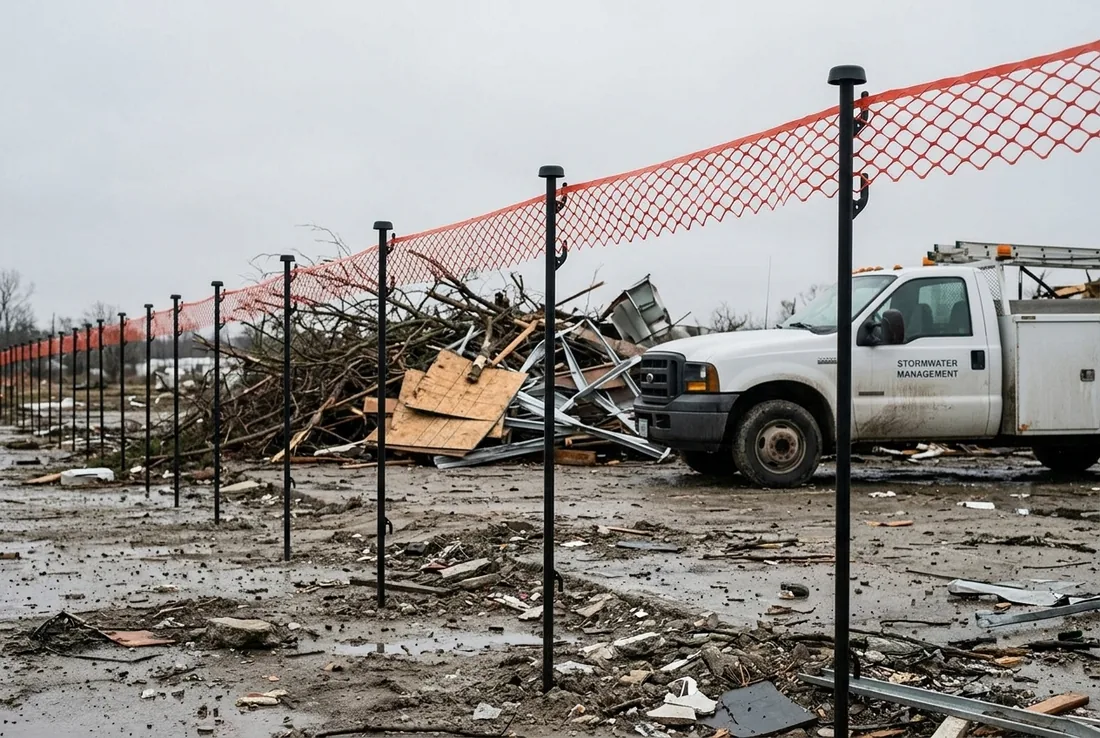
Emergency and disaster-relief site fencing secures the perimeter of an incident or recovery site — a demolition zone, a relief-supply staging yard, a utility laydown area — fast, before the site can be controlled any other way. The binding constraint is the clock: the boundary has to go up in hours, stay safe around debris and the public, and come back down for the next incident. Reusable, rapid-deploy barrier posts that install up to 8x-10x faster than driven posts fit that pattern, which is why Scepter lists “Disaster Relief: Rapid Barrier Deployment” as a core competency.
Why an emergency site needs a perimeter — and why normal jobsite rules don’t fit
A disaster or emergency site has the same perimeter needs as any construction site — keep people out of hazards, protect equipment and supplies, define who is inside the controlled zone — but it strips away the one thing a normal jobsite has: lead time. There is no week-two mobilization. The fence is part of the first operational period.
What you are usually enclosing:
- Donated supplies, fuel, generators, and heavy equipment that walk off an unsecured site.
- The public, away from real hazards — unstable structures, sinkholes, downed lines, contaminated ground, open excavations.
- A defined controlled zone so responders, inspectors, and contractors know where the site edge is.
The same speed, reuse, and safety questions that drive construction site fencing choices show up here, just compressed into hours instead of weeks.
The clock problem: hours, not days
Speed is the constraint that decides everything else. Scepter lists rapid deployment as a core differentiator — installation and dismantling up to 8x-10x faster than conventional methods, with the labor savings that follow. On an emergency timeline that is the difference between a site that is secured on day one and one that is still open when the first crews and the first onlookers arrive.
Driven T-posts struggle exactly where an emergency needs them most: impact-tool installation is slow and hazardous on unknown or debris-covered ground, and teardown is labor-heavy when the site has to be cleared for the next phase. That trade-off is the whole reason to weigh panels versus posts before, not during, an incident.
Where emergency-site fencing gets used
These are all perimeter-boundary uses — enclosing a site, not pushing back a crowd. (More on that distinction below.)
| Site type | What you're enclosing |
|---|---|
| Post-disaster demolition & recovery zones | Unstable structures, debris fields, and the equipment working them |
| Relief & aid staging / distribution yards | Donated supplies, fuel, generators, and the working footprint |
| Wildfire, flood & storm site control | Hazard areas and controlled access points into the zone |
| Utility & infrastructure restoration | Laydown yards, crew areas, and energized work zones |
| Temporary shelter, medical & support sites | The site perimeter and a clear, controlled entry |
In every row the job is the same: a clear edge, set fast, that holds up around debris and foot traffic and comes apart cleanly when the site moves.
Safety on a high-hazard site
A recovery site has more ways to hurt someone than a tidy jobsite: uneven and unknown ground, sharp debris, and members of the public who should not be there but are. That is the case for better fence hardware, not against it.
Scepter builds eight safety features into the post, including a built-in cap that covers the tube end rather than leaving an exposed top to guard against. Compared with the exposed tops and impact-tool installation of driven posts — the specific hazards laid out in T-post safety on construction sites — that lowers the liability the site is already carrying.
Built to move, and to come back
Relief and recovery work is repetitive: the same stock moves from one incident to the next. A system built around reusable, recyclable materials redeploys instead of being driven, pulled, and scrapped each time — the source of Scepter’s stated “savings per mile” and the reason a reusable post pencils out against re-renting or re-driving for every event. The break-even math is the same one laid out in temporary fence rental cost versus reusable posts, just run across incidents instead of months.
Procurement for agencies and responders
For US agencies, emergency-management offices, and prime contractors, the buying path matters as much as the product. Scepter is a veteran-employing LLC, active in SAM.gov under CAGE Code 0QFR2, with a dedicated government-sales contact (gov@scepterpost.com) and acceptance of purchase cards and ACH/wire. The published Capabilities Statement lists the full core competencies — including “Disaster Relief: Rapid Barrier Deployment” and “Disaster Response” — alongside the NAICS and registration detail a contracting officer needs.
When rapid-deploy reusable posts fit an emergency site — and when they don't
Reach for a reusable, rapid-deploy barrier post when the priority is enclosing a site fast, with one crew, on ground you can’t survey first, and reusing the same inventory across repeated incidents. It is not the tool for holding back a crowd under physical pressure — that is a job for engineered steel barricades — and it is not a substitute for a permanent security fence once a site stabilizes for the long term.
The bottom line
Emergency and disaster-relief site fencing is a speed problem first and a safety problem second. A reusable barrier-post system that goes up 8x-10x faster than driven posts, carries its safety features built in, and redeploys to the next incident is built for exactly that pattern — which is why it sits in Scepter’s own disaster-response and temporary-enclosure applications, not at the edge of them. Keep it to the perimeter, match the barricade question to the one place crowd pressure actually builds, and the rest is logistics.
Securing an emergency or recovery site?
Send the site type, rough perimeter footage, and how fast it has to go up. A Scepter rep can scope a rapid-deploy, reusable barrier-post setup and walk agency buyers through the procurement path.
Frequently asked questions
What is emergency or disaster-relief site fencing?
It is temporary perimeter fencing put up to secure the boundary of an incident or recovery site — a demolition zone, a relief-supply staging yard, a utility laydown area — usually within the first operational period, before the site can be controlled any other way. The job is to define and protect the site edge, not to hold back a crowd.
How fast can an emergency site perimeter go up?
That is the whole point of the product class. Scepter lists rapid deployment as a core differentiator: installation and dismantling up to 8x-10x faster than conventional methods. In practice a reusable barrier-post system lets one crew enclose a site in a single shift without impact tools or heavy equipment, which is what makes it usable in an emergency timeline.
Is this the same as crowd-control barricades?
No, and the difference matters for safety. Site fencing defines a perimeter boundary. Holding back a dense crowd under physical pressure — at an aid-distribution pinch point, for example — is a separate job that calls for engineered, interlocking steel barricades rated for crowd loads. Use perimeter fencing to enclose the site, and purpose-built barricades only at the specific point where crowd pressure builds.
Can the same fencing be reused on the next incident?
Yes. The system is built around reusable, recyclable materials, so the same inventory redeploys across incidents instead of being driven, pulled, and scrapped each time. That is where the 'savings per mile' comes from, and it suits relief logistics where the same stock moves from one site to the next.
Can government agencies and primes buy it on contract?
Scepter is a veteran-employing LLC that is active in SAM.gov under CAGE Code 0QFR2, with a dedicated government-sales contact (gov@scepterpost.com) and acceptance of purchase cards and ACH/wire. Exact NAICS and registration details are in the published Capabilities Statement.
How is this safer than driven T-posts on a debris-strewn site?
Driven posts leave an exposed top that has to be capped, and impact-tool installation is slow and hazardous on unknown or debris-covered ground. Scepter builds eight safety features into the post, including a cap that covers the tube end rather than leaving an exposed point — which matters more, not less, on a high-hazard recovery site with the public nearby.
Sources & standards
Figures and requirements on this page were checked against primary and industry sources. Always confirm against the governing permit, spec, or a current quote.